


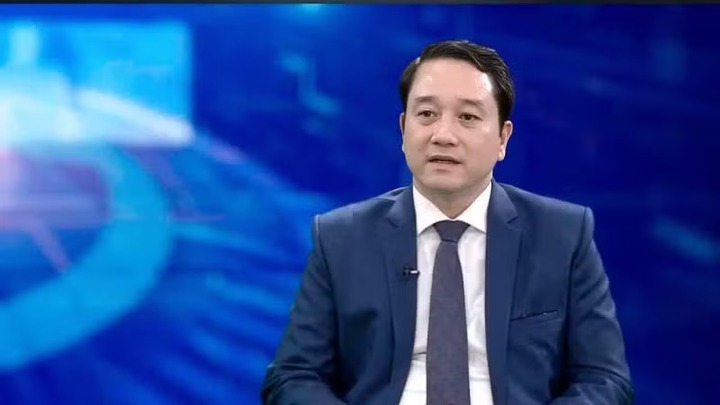
Associate Professor, Dr. Dao Ngoc Chien, Director of the National Foundation for Science and Technology Development (NAFOSTED). Photo: Nhan Dan Newspaper
A prominent new feature is the shaping of the Foundation’s model according to international standards, harmonising basic and applied research, with a flexible funding mechanism linked to results and each stage of implementation. Regarding this topic, Nhan Dan Newspaper had an interview with Associate Professor, Dr. Dao Ngoc Chien, Director of the NAFOSTED.
Q: What innovations are expected in this draft Decree to improve the effectiveness of research funding and strengthen the role of connecting the domestic and international scientific community?
A: The innovations of the Law on Science, Technology and Innovation are all concretised in this draft Decree. In particular, the draft thoroughly implements the principles and viewpoints of the 14th National Congress on the development of science, technology, innovation, and national digital transformation as the main driving force of national development, establishing a new growth model associated with double-digit growth.
The draft Decree clearly states the operational objective is to shape a model for a fund to finance scientific research and technological development that ensures independence, transparency, and competitiveness according to international standards.
One of the outstanding new points of the draft is the financial mechanism designed to be more flexible, shifting from input-based management to output-based evaluation.
The Fund is allocated funding based on the total amount and without a specific list of tasks at the time of budget allocation and funding disbursement, providing a basis for the Fund to proactively develop, approve tasks, and organise the implementation of funding, commissioning, and support within its authority, ensuring alignment with the established goals, priorities, and allocation structure.
The Fund also manages funding, commissioning, and support activities based on results and output impact; ensuring a balance between research with inherent potential and low risk, and research with pioneering, breakthrough, and high risk; accepting scientific and technological risks within a controlled scope, ensuring encouragement of creativity and innovation; respecting the objective laws and specific characteristics of scientific, technological, and innovative activities…
Thus, funding activities harmonise basic research with applied research. Basic research, being pioneering, breakthrough, and high-risk, is subject to lump-sum funding regulations, while applied research with specific results is funded based on allocation of funds for each milestone achieved, rather than according to a budget package or contract schedule. Projects will present their results, complete reports, and receive funding approval for the next stage of implementation.
Thus, funded science and technology projects will no longer be heavily focused on document verification but will concentrate on evaluating effectiveness, using practical impact as a funding criterion.
These new regulations will help increase the Fund's proactiveness by allocating budgets based on the total amount, instead of disbursing funds in instalments as before. With a stable budget allocation, the Fund can flexibly adjust and promptly meet emerging needs, including unexpected projects, thereby improving the efficiency and timeliness of funding.
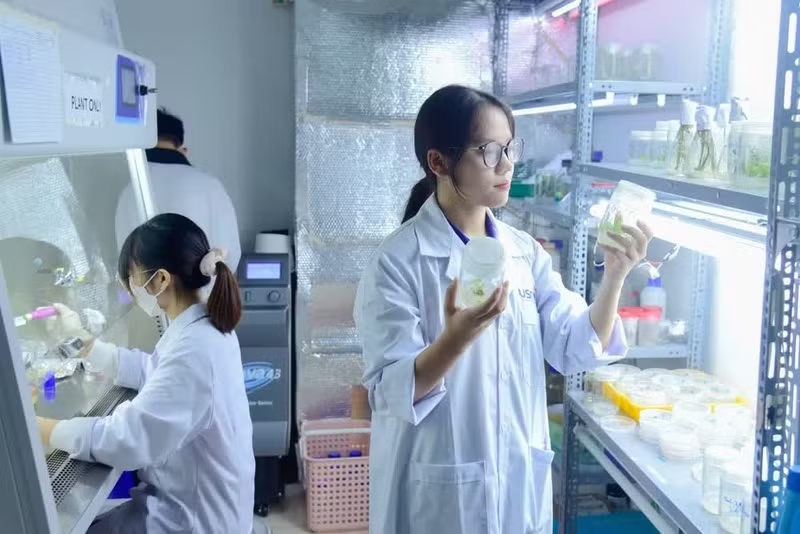
Research conducted at the University of Science and Technology of Ha Noi (USTH)..Photo: Nhan Dan Newspaper
Q: Could you please elaborate on the risk management mechanism in funding activities?
A: Risk management is addressed right from the project selection stage. Each proposed project undergoes a risk assessment through consultations with scientific councils. Chapter 6 of the draft Decree on “Risk Management” clearly stipulates the risk management responsibilities of organizations and individuals undertaking scientific and technological tasks funded or commissioned by the Fund, as well as the content of the Fund's own risk management.
Specifically, upon receiving reports from the lead organisation and individuals undertaking scientific and technological tasks funded or commissioned by the Fund regarding the occurrence of risks, the Fund conducts surprise inspections and assessments to examine the ability to respond to and mitigate consequences, and to determine the causes and extent of the risks' impact.
In the event of detecting signs of fraud or intentional violations of the law during the performance of the task, the Fund will report and recommend that the competent authority consider and handle the matter according to the law…
However, our consistent approach is to accept controlled risks. In the event that the task does not achieve the final result, if the organisation or individual performs according to professional procedures, management regulations, and ensures transparency, they will be considered for exemption from administrative liability and will not have their funds recovered according to current regulations.
Q: Regarding the policy on developing scientific human resources, what new support mechanisms are included in the draft?
A: The draft dedicates a separate chapter - Chapter IV “Support for activities to enhance national scientific and technological capacity”; which includes content on enhancing the capacity of the scientific and technological workforce.
In particular, young scientists with high potential and qualifications will benefit from various practical forms of support, such as: funding for short-term internships and research abroad; research activities for postdoctoral researchers; research activities for doctoral and master's students; inviting outstanding foreign scientists to Viet Nam for short-term academic exchanges; support for talented young scientists and engineers, etc.
Notably, the draft adds regulations on research activities of outstanding scientists with remarkable achievements in scientific research and technological development, aiming to create conditions for strong research groups to develop, thereby enhancing Viet Nam’s potential in science, technology, and innovation; and elevating the position of Viet Nam’s science and technology sector internationally.
A key new point outlined in Article 26, “Support for Technology Verification Activities” - Chapter IV, in the draft aims to assess scientific and technical feasibility, refine verification data, and meet technology readiness requirements for the technology completion or transfer phase. This is a crucial step before a startup (also known as pre-startup) - the transitional phase before the formation of a startup business.
It’s understandable that when a young research team has a very creative idea but hasn't yet developed a product, if the idea's applicability and practicality are verified and they receive funding to complete the product, it could very well be the starting point for a successful startup. Many successful startups around the world, including tech unicorns, have started from this stage.
Thank you very much!
