


At the working session, Mr. Vikram Rao proposed strengthening cooperation with Viet Nam across four focus areas: developing sovereign Large Language Models (LLMs), building AI infrastructure and GPU capacity, training human resources and fostering startups, and bringing Viet Nam's AI ecosystem to regional and global markets.
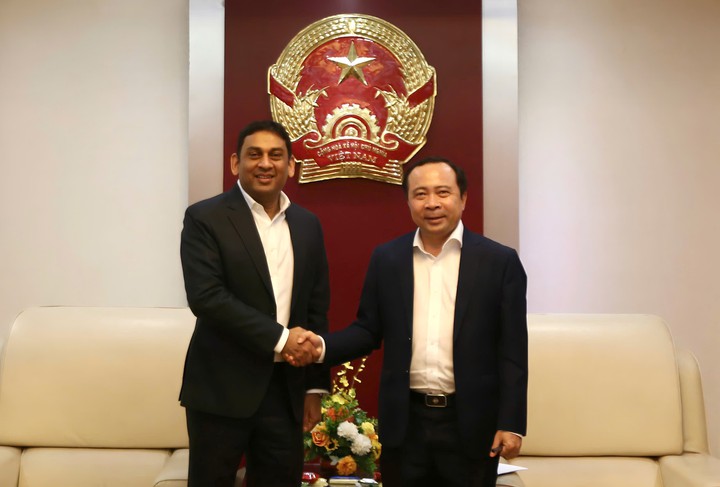
Minister of Science and Technology Vu Hai Quan receives Mr. Vikram Rao, Vice President of NVIDIA and Managing Director for the ASEAN region
NVIDIA representative commended Vietnam's progress in developing its AI ecosystem, highlighting the active involvement of enterprises, educational institutions, and technology partners. NVIDIA has established partnerships with several major Vietnamese firms, including FPT, Viettel, GreenNode, and others, to develop AI infrastructure and capabilities.
NVIDIA outlined four strategic pillars for cooperation:
First, NVIDIA proposed collaborating with Viet Nam to build locally owned LLMs. The company noted it is developing open-source models, including Nemotron, alongside tools, datasets, and support solutions to enable nations to train tailored models aligned with their specific language, data, and national requirements.
Second, in terms of AI Infrastructure and GPU capacity, NVIDIA highlighted that Viet Nam currently operates approximately 10,000 - 15,000 GPUs, whereas countries like South Korea possess around 50,000 - 60,000 GPUs and plan to scale to 200,000 - 250,000 GPUs within the next five years. NVIDIA recommended that Viet Nam formulate a national strategy to expand AI computing capacity to serve government agencies, enterprises, universities, and research institutions.
Third, in terms of human resources, startups, research, and education, NVIDIA proposed scaling up its Deep Learning Institute (DLI) programs nationwide and integrating them deeper into academic curricula. Recognizing Viet Nam as one of ASEAN’s most dynamic startup markets, NVIDIA expressed a desire to bolster support for local AI startups, while facilitating access for researchers, doctoral candidates, and students to the NVIDIA AI ecosystem.
Forth, NVIDIA proposed connecting Viet Nam’s AI ecosystem with global networks, initially helping local AI products, enterprises, and capabilities expand into ASEAN before scaling globally.
Minister Vu Hai Quan noted that NVIDIA’s four proposals align well with Viet Nam’s national strategies for science, technology, innovation, and digital transformation. He instructed focal units within the Ministry to coordinate with NVIDIA to translate these proposals into a joint action plan with clearly defined tasks, resources, and implementation roadmaps.
Welcoming the initiative, NVIDIA representatives affirmed their readiness to co-develop the structured plan to achieve tangible early results for joint review and implementation./.
