


This will elevate science, technology, innovation, and digital transformation into a vital pillar of the special relationship between the two nations.
The statement was made during the working session between Minister Vu Hai Quan and the Ambassador of Cuba to Viet Nam, Rogelio Polanco Fuentes, on July 31, 2026.
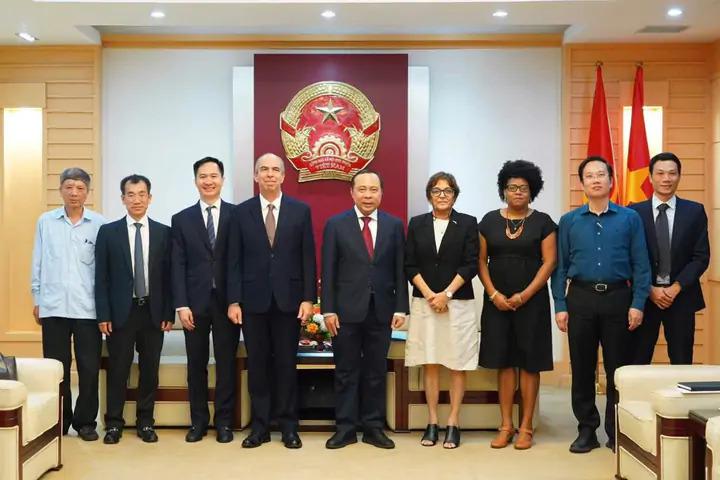
Minister Vu Hai Quan, Ambassador Rogelio Polanco Fuentes and delegates pose for a group photo
Practical results in bilateral cooperation
At the meeting, Ambassador Rogelio Polanco Fuentes highlighted that the relationship between Viet Nam and Cuba is a traditional, solidary, and special fraternal friendship, nurtured by President Ho Chi Minh, Cuban leader Fidel Castro, and generations of leaders and citizens of both countries. Within this overall framework, scientific and technological cooperation plays an increasingly crucial role in the socio-economic development of both nations.
According to the Ambassador, the scientific and technical cooperation program under the Viet Nam–Cuba Intergovernmental Committee framework has yielded many practical results. Outstanding areas of collaboration include food production, agriculture, renewable energy, digital transformation, biotechnology, pharmaceuticals, and strategic technologies.
In agriculture, Cuba has received high-yield rice varieties, advanced technology, and production management methods from Viet Nam, contributing to higher yields and enhanced food security. Solar energy projects implemented by Vietnamese partners have also assisted Cuba in easing power shortages and strengthening energy security. In biotechnology and pharmaceuticals, a joint venture at the Hoa Lac Hi-Tech Park successfully transferred monoclonal antibody production technology, marking a major milestone in bilateral cooperation.
The Ambassador expressed Cuba's desire to expand cooperation beyond technology transfer and production setup in Viet Nam, moving toward joint research tasks, new product development, and the commercialization of research outcomes.
Five directions for cooperation expansion
In response, Minister Vu Hai Quan emphasized that the Viet Nam–Cuba relationship is an invaluable asset, deeply cherished and preserved by the leaders and peoples of both nations.
According to the Minister, ample room remains for further cooperation in science, technology, innovation, and digital transformation, particularly in biotechnology, agriculture, medicine, herbal pharmaceuticals, and information technology.
On this basis, Minister Vu Hai Quan proposed five key directions for cooperation in science, technology, innovation, and digital transformation:
-Strengthening delegation exchanges and fostering linkages between scientists, research institutes, and universities of both countries.
- Sharing policy development experiences in STI&DT to leverage each country's respective strengths.
- Implementing expert exchange programs.
- Promoting postgraduate training, granting scholarships, and expanding doctoral candidate exchanges.
- Broadening cooperation in training and exchanging doctors and young medical personnel.
The Minister expressed his hope that both sides will soon formulate a concrete action plan to establish STI&DT cooperation as a fundamental pillar in Viet Nam–Cuba relations.
At the conclusion of the session, both sides agreed to maintain close coordination to translate these proposals into concrete programs and projects, thereby deepening the special friendship, fraternal solidarity, and comprehensive cooperation between Viet Nam and Cuba./.
