

Ready for Phase 2 of the Viet Nam - Korea Institute of Science and Technology Project
<p style="text-align: justify;">Phase 2 of the VKIST Project is expected to run from 2026 to 2033 with $30 million in non-refundable ODA from South Korea, focusing on strategic technology research, human resource training, and promoting technology transfer and commercialization.</p>
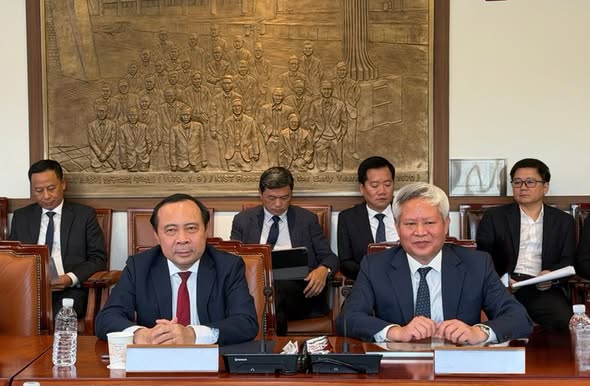
Minister of Science and Technology Vu Hai Quan at the meeting (left)
On the afternoon of September 30, 2026, during his working visit to South Korea, Minister of Science and Technology Vu Hai Quan and his delegation visited and held a working session at the headquarters of the Korea Institute of Science and Technology (KIST). KIST President Oh Sang Rok received the delegation. The two sides discussed expanding research cooperation and the next phase of the Viet Nam–Korea Institute of Science and Technology (VKIST) Project.
At the meeting, Minister Vu Hai Quan proposed four key areas of cooperation, including elevating joint research in strategic fields such as semiconductor integrated circuits, artificial intelligence (AI), batteries and energy storage, advanced materials, and biotechnology.
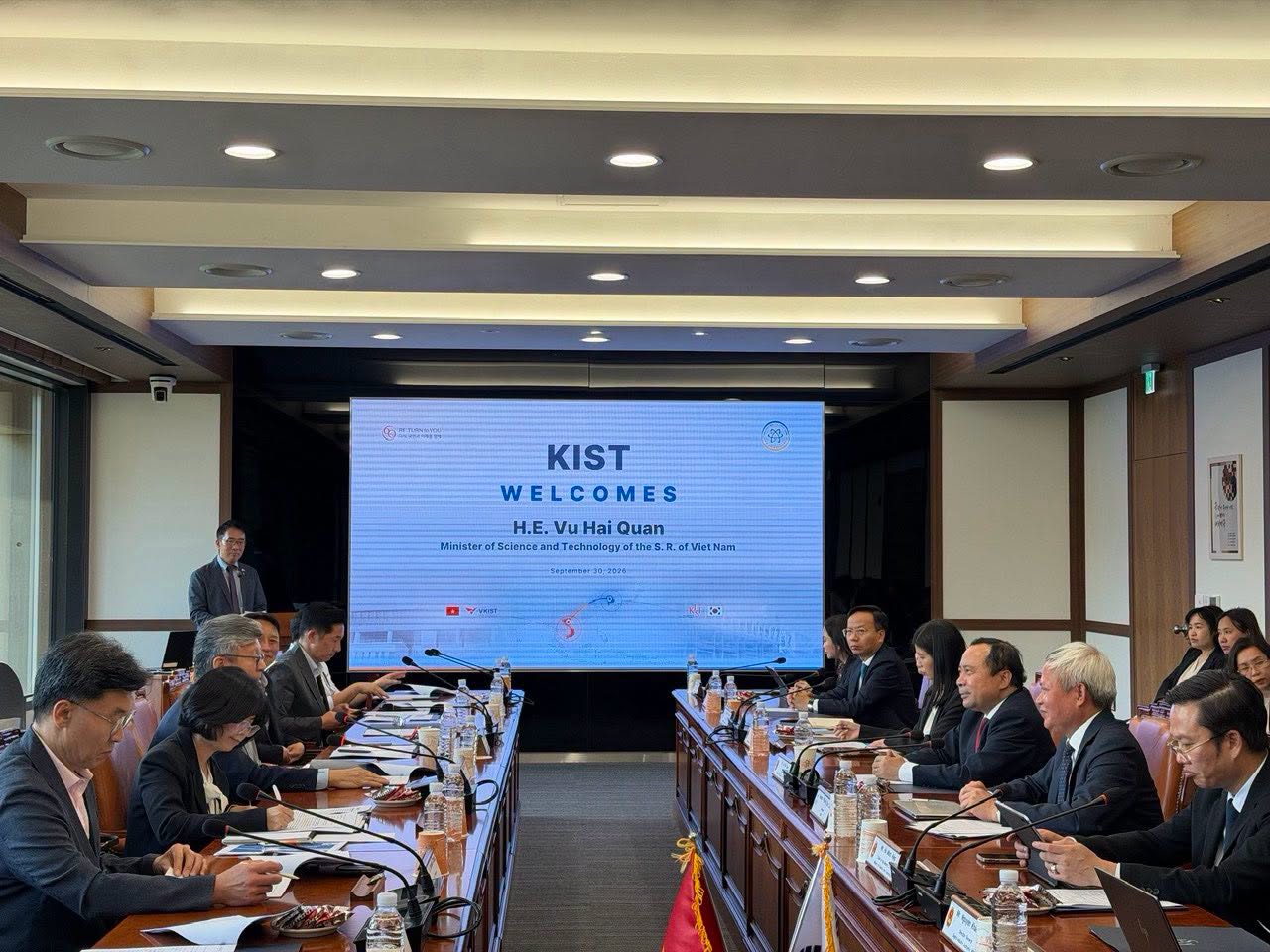
Overview of the meeting
Alongside research cooperation, the Minister suggested establishing a mechanism for shared use of research and development (R&D) infrastructure and state-of-the-art equipment among KIST, VKIST, and Viet Namese research institutes and universities.
Regarding human resources, the Minister proposed sending Vietnamese researchers to work directly at KIST, while partnering with KIST School for long-term master's and doctoral degree programs. The remaining key area is advancing the VKIST R&D Project for the 2026–2033 period.
KIST President Oh Sang Rok affirmed that VKIST represents a unique symbol of bilateral cooperation, pledging KIST's continued support to ensure the project moves forward on schedule and becomes a core R&D hub effectively bridging research institutes and businesses in both countries.
Phase 1 of the VKIST Project had a total capital of approximately $70 million, including $35 million in non-refundable ODA from South Korea. The first phase established physical infrastructure, laboratories, and an operational foundation for an applied research institute serving industry.
Building on this foundation, Phase 2 is planned for implementation from 2026 to 2033 with $30 million in non-refundable ODA across five components.
Under these plans, the project expects to execute 38 joint R&D projects in strategic technologies; facilitate technology transfer and commercialization; and train human resources, including supporting 20 Ph.D. candidates in South Korea. The remaining two components focus on developing research infrastructure for semiconductors, secondary batteries, and shared laboratories, as well as project management.
Project documents are currently being finalized for approval, paving the way for Phase 2 to strengthen Viet Nam–South Korea research linkages and connect research institutes with enterprises.
Following the meeting, the delegation from the Ministry of Science and Technology toured KIST's advanced technology laboratories and manufacturing facilities, featuring quantum chip technology, intelligent humanoid robotics, and recognition AI designed to assist in searching for missing persons and detecting natural disasters such as forest fires.
Established in 1966, KIST was the first multidisciplinary research institute created by the South Korean government, playing a crucial role in developing industrial technology and scientific and technological talent. The KIST model served as the foundation for establishing VKIST in Viet Nam./.