

IP enforcement actions triple as government tightens oversight
<p style="text-align: justify;">Since the Prime Minister issued Directive 38, which directs ministries and agencies to strengthen efforts against IP violations, 1,438 cases had been detected and processed as of May 27.</p>
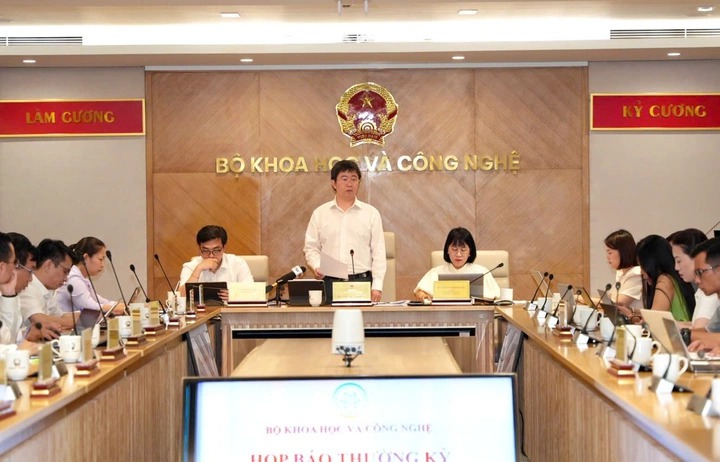
The Ministry of Science and Technology holds its monthly press briefing on June 1. Photo: VNA
More than 1,400 intellectual property (IP) violations have been uncovered in less than a month under a nationwide enforcement campaign, the Ministry of Science and Technology said on June 1, highlighting a sharp increase in action against infringement.
Since the Prime Minister issued Directive 38 on May 5 this year, which directs ministries and agencies to strengthen efforts against IP violations, 1,438 cases had been detected and processed as of May 27.
Of those, 1,146 were handled through administrative penalties and 28 were referred for criminal investigation. Total fines exceeded 12.6 billion VND (roughly 480,000 USD), while the estimated value of seized infringing goods reached approximately 35.7 billion VND (about 1.4 million USD).
The pace of enforcement has accelerated significantly. Tran Le Hong, deputy director of the National Office of Intellectual Property, said that within just three weeks, the number of administrative cases processed was running at around three times the monthly average recorded throughout 2025.
The number of IP-related criminal cases referred for prosecution had already reached about 60% of the total recorded in all of 2025. Enforcement actions by the market surveillance force also increased by about 210% compared with May 2025.
On the regulatory front, the ministry has submitted a draft decree to Prime Minister Le Minh Hung that would allow authorities to block access to domain names found to infringe industrial property rights.
The proposed measure is intended to speed up enforcement and address a longstanding challenge, as international domain registrars without a legal presence in Vietnam have often proved difficult to compel into compliance.
Hong also said his office had held working sessions with C03, the Ministry of Public Security's agency responsible for investigating corruption, economic crimes and smuggling, as well as market surveillance officials in the Mekong Delta city of Can Tho, to coordinate enforcement efforts under Directive 38.
The office also issued eight formal notices to agencies nationwide regarding 37 suspected trademark infringement cases.
The ministry announced plans to establish a national IP enforcement database this year. The system would consolidate enforcement records and case histories, providing agencies with a shared platform to retrieve and cross-reference information more efficiently.
"It will be a powerful tool for statistics, forecasting trends in IP infringement and informing policy," Hong said.
The briefing also highlighted a number of developments in innovation and digital transformation.
Vietnam climbed five places to rank 50th globally in StartupBlink's 2026 Global Startup Ecosystem Index, its highest position to date.
The country's innovation ecosystem now includes 963 science and technology enterprises, 20 technology exchange platforms and 37 innovation centres across 26 of Vietnam's 34 provinces and centrally administered cities.
In digital transformation, the digital economy contributed an estimated 14.02% of GDP in 2025, equivalent to around 72.1 billion USD.
Vietnam ranked 11th globally for telecommunications infrastructure, with average mobile broadband speeds of 207.3 Mbps and fixed broadband speeds of 287.33 Mbps.
The country has 110.5 million mobile broadband subscribers, including 24.29 million 5G users, and 25.62 million fixed broadband subscribers. Postal service revenue in May was estimated at 8.5 trillion VND (323 million USD), up 30% year-on-year.
May also saw significant international engagement. Party General Secretary and State President To Lam attended the Vietnam – India Innovation Forum in New Delhi. The ministry held bilateral talks with Sri Lanka on cooperation in 6G, drones and satellite technology, and participated in international forums on artificial intelligence, semiconductors and digital infrastructure in Singapore, the US, Thailand and the Philippines.
Domestically, the ministry organised a series of events to mark Science, Technology and Innovation Day on May 18, including a science book fair themed Knowledge – Building a Digital Nation and a technology marketplace focused on AI applications.
Looking ahead, the ministry said it would focus on implementing Resolution 57, a key directive on science and technology development, by refining the legal framework governing science and technology, digital transformation and telecommunications.
It also plans to advance strategic technologies, restructure national science and technology programmes and submit a national digital architecture framework to the Prime Minister as a foundation for comprehensive digital transformation in the years ahead./.