

Digital transformation towards smart governance and proactive public services
<p style="text-align: justify;">On September 23, 2026, Ministry of Science and Technology held a seminar to exchange digital transformation experiences with a delegation from the Government Technology Agency of Singapore (GovTech Singapore), led by Chief Executive Goh Wei Boon.</p>
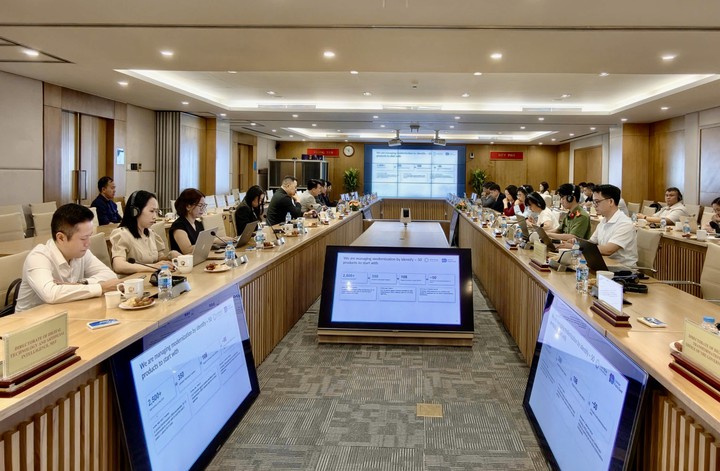
Overview of the working session
In his opening remarks, Deputy Minister Le Xuan Dinh stated that Viet Nam is entering a new phase of national digital transformation. Current requirements extend beyond merely digitizing processes or building additional information systems; they demand fundamental shifts in governance approaches, operational models, and service delivery across government agencies.
This transition requires shifting from isolated, siloed systems to shared platforms, and moving from on-demand public service provision to proactive, intelligent, and citizen-centric digital services. These remain critical areas for Viet Nam to research further and draw upon practical international experience as it develops its digital government framework.
The Deputy Minister requested that participating units focus on practical issues currently arising in digital transformation, particularly national digital architecture management, shared platform governance, technology investment and procurement, and the development of next-generation online public services.
According to the Deputy Minister, digital architecture must truly serve as a tool for investment governance and system integration. Shared platforms should be designed to enhance usability and reusability while curbing fragmentation and duplicate investment. Procurement and investment mechanisms must keep pace with the rapid advancement of cloud computing, software, data, and AI, while ensuring efficiency and transparency.
Regarding online public services, the focus must shift from procedure digitization to data-driven, user-journey service design, progressively advancing toward proactive service delivery. The Deputy Minister expressed hope that through the seminar, both sides would clarify actionable insights, areas for further study, and concrete avenues for future cooperation.
In response to the key themes raised, Authority of National Digital Transformation and GovTech Singapore focused their exchanges on digital government organization, shared platform governance, tech investment, public sector technical capacity building, data sharing, and AI deployment.
A major topic of discussion was the delineation between centralized national systems and domain-specific systems managed independently by individual ministries and agencies.
GovTech shared that Singapore focuses on developing foundational systems centrally, while operational systems can be independently built or outsourced by specific agencies. However, regardless of the chosen model, public sector agencies must maintain sufficient technical capability to understand, manage, and control their systems, avoiding total dependence on external vendors.
Both sides also discussed transitioning from project-based management to life-cycle digital product governance.
According to GovTech’s experience, digital products are evaluated based on adoption rates, user satisfaction, cost efficiency, and actual value delivered. Product development involves early engagement from product management, design, and engineering teams, thereby tightly aligning business requirements with system construction, operation, and ongoing iteration.
Furthermore, data sharing and AI implementation occupied significant discussion time. Key topics included inter-agency data-sharing mechanisms, cloud infrastructure utilization, and data classification and governance when integrating into AI systems.
GovTech noted that AI application is being actively accelerated within internal workflows to boost productivity, whereas public-facing applications are deployed more cautiously alongside appropriate control mechanisms./.