

Bringing technology from lab to oilfield
<p style="text-align: justify;">Scientists and oil and gas experts are selecting technologies capable of addressing operational challenges in enhanced oil recovery, water-shutoff treatments, downhole flow monitoring, and structural integrity management, targeting field trials during the 2026–2030 period.</p>
From August 20 to 22, 2026, in Da Lat, the Center for Applications of Nuclear Technique in Industry (CANTI) under the Vietnam Atomic Energy Institute (VINATOM), in collaboration with the Viet Nam-Russia Joint Venture Vietsovpetro (VSP), organized a scientific and technological workshop titled "Application of Science and Technology to Enhance Oil Production Efficiency."
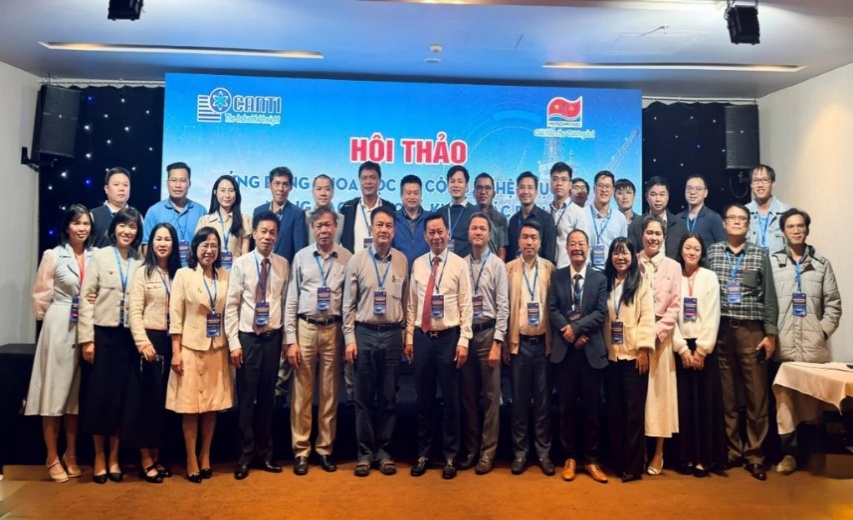
Leaders, experts, and delegates from CANTI, VINATOM, Vietsovpetro, and participating units at the workshop.
The workshop focused on bridging the practical requirements of oil exploration and production with scientific and technological solutions capable of research, testing, and deployment under field conditions.
Held within the framework of a cooperation agreement between the Viet Nam National Energy and Industry Group (PVN) and VINATOM, the workshop prioritized in-depth discussion, critical evaluation, and the identification of potential areas to translate into specific research tasks, trials, or collaborative initiatives.
Through seven specialized technical papers and multiple panel discussions, the event covered a range of issues directly impacting oilfield operations, including reservoir connectivity, water sources, downhole flow monitoring, enhanced oil recovery, water-shutoff management, inorganic scale deposition control, drill cuttings analysis, and structural integrity assessment.
A key highlight of the event was shifting the focus from "what the technology offers" to "what practical operational problems the technology can solve." Highlighting this approach, CANTI Director Bui Quang Tri presented proposed strategic cooperation guidelines between CANTI and Vietsovpetro, positioning each technology relative to production requirements, field trial conditions, and anticipated performance.
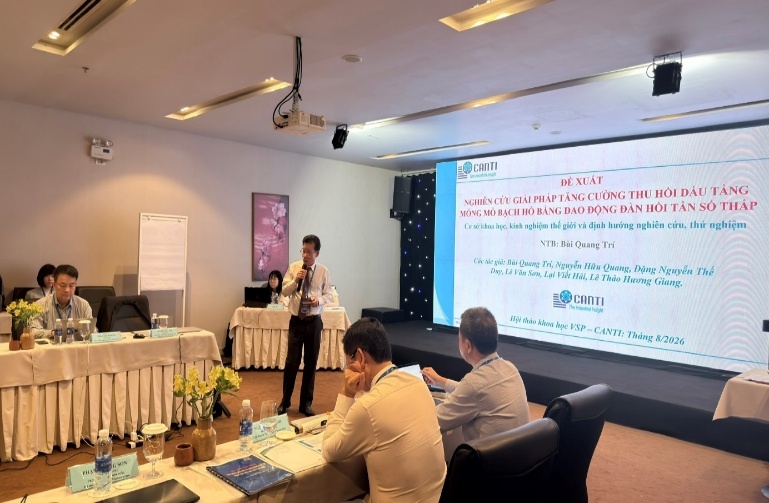
A technical presentation at the workshop focusing on technological solutions to enhance oil production efficiency.
Speaking at the workshop, Nguyen Lam Anh, Deputy General Director of Vietsovpetro, recognized CANTI's collaboration under the principles of "science, quality, reliability, timeliness, and cost-effectiveness." He praised VINATOM’s ongoing support in researching, developing, and applying technologies to survey and study Vietsovpetro’s oilfields.
Building on the technical presentations and discussions, key initiatives were identified for evaluation during the 2026–2030 phase. These outcomes mark a step forward in aligning production needs with viable research and field testing pipelines.
One of the greatest values of the workshop lies not in the number of presentations, but in the joint identification of pressing problems, high-potential technologies, and actionable next steps. Addressing core questions such as "Which technology directly matches Vietsovpetro's needs?", "Which technology is mature enough for further development?", and "Which technology can be selected for field trials?" has brought science and technology integration much closer to practical production requirements.
The shared direction pursued by CANTI and Vietsovpetro is to shift progressively from research to application: moving beyond laboratory-scale results to select, pilot, evaluate, and incrementally deploy suitable solutions in the field. This approach aligns with the demand to innovate scientific and technological activities by anchoring them to enterprise needs, ensuring measurable efficiency, and generating practical value for production.
The workshop titled "Application of Science and Technology to Enhance Oil Production Efficiency" contributed significantly to strengthening cooperation between CANTI and Vietsovpetro. The key directions agreed upon serve as the foundation for both parties to refine their proposals, select priority tasks, and implement joint research and field trials during the 2026 - 2030 period./.